Marie Lunau Dejgaard
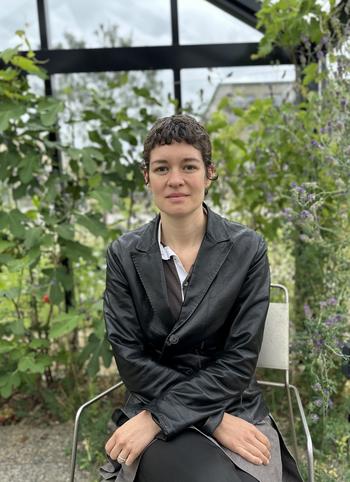
Marie Lunau (she/her) is a queer theorist interested in questions of gender, sexuality, migration, asylum, racialisation, anticolonialism, feminist epistemologies, affect theory and archival studies. Marie is currently employed as a postdoctoral fellow in the Department of Communication and Arts, Roskilde University in Denmark on the project “New Histories of Female Same-Sex Relations 1870-2020”. Before joining the project, she received her PhD in Sociology in 2024, entitled The Affective Politics of Queer Migration: On Affective Ambivalence, Truth and Queerness.
Marie Lunau's research interests are related to questions of gender, sexuality and affect within historical contexts of queer archives as well as within queer asylum, migration and belonging. She is also interested in anticolonial perspectives, resistance, feminist epistemologies and affect theory.
Publications (selected)
Lunau, M. (2026). Archives of Affective Ambivalence in the Governance of Queer Asylum. Ethnic and Racial Studies. https://doi.org/10.1080/01419870.2026.2630106
Lunau, M. (2026). Flora’s Space: Archiving Queer Love through Letters and Affections. Journal of Homosexuality, 73(3), 638–658. https://doi.org/10.1080/00918369.2025.2481459
Lunau, M. and Schröder, R. (2025). Coloniality in Queer Asylum: Towards Theorising ‘Colonial Surveillance’ and its Resistances. Journal of Ethnic and Migration Studies, 51(9), 2166–2182. https://doi.org/10.1080/1369183X.2025.2452260
Lunau, M. (2023). Translating Knowledge: Towards an Affective Methodology of Navigating Intimacies, Reflexivity and Moments of Untranslatability. European Journal of Politics and Gender, 7(1): 65-82. https://doi.org/10.1332/25151088Y2023D000000014
Lunau, M. and Andreassen, R. (2022). Danish Immigration Authorities’ Media Surveillance of Queer Asylum Seekers. European Journal of Cultural Studies, 26(6):655-671. 10.1177/13678779221140129
Lunau, M. (2019). The Trouble with ‘Truth’: On the Politics of Life and Death in the Assessment of Queer Asylum Seekers. Kvinder, Køn & Forskning (Women, Gender & Research), 28(3-4): 2-13. 10.7146/kkf.v28i2-3.116305